
Theory of PME
THEORY OF PME | workshop | 12 hours over one weekend | Sat 03.04.2027 and Sun 04.04.2027 | 2pm – 8pm (Vienna time) | € 249,- | only for enrolled students of THE BASIC SOMATIC TRAINING |
To participate in this module, you need to be enrolled in the Basic Somatic Training.
If you did choose the payment option >pay per module< please book this workshop here
Transform your professional practice.
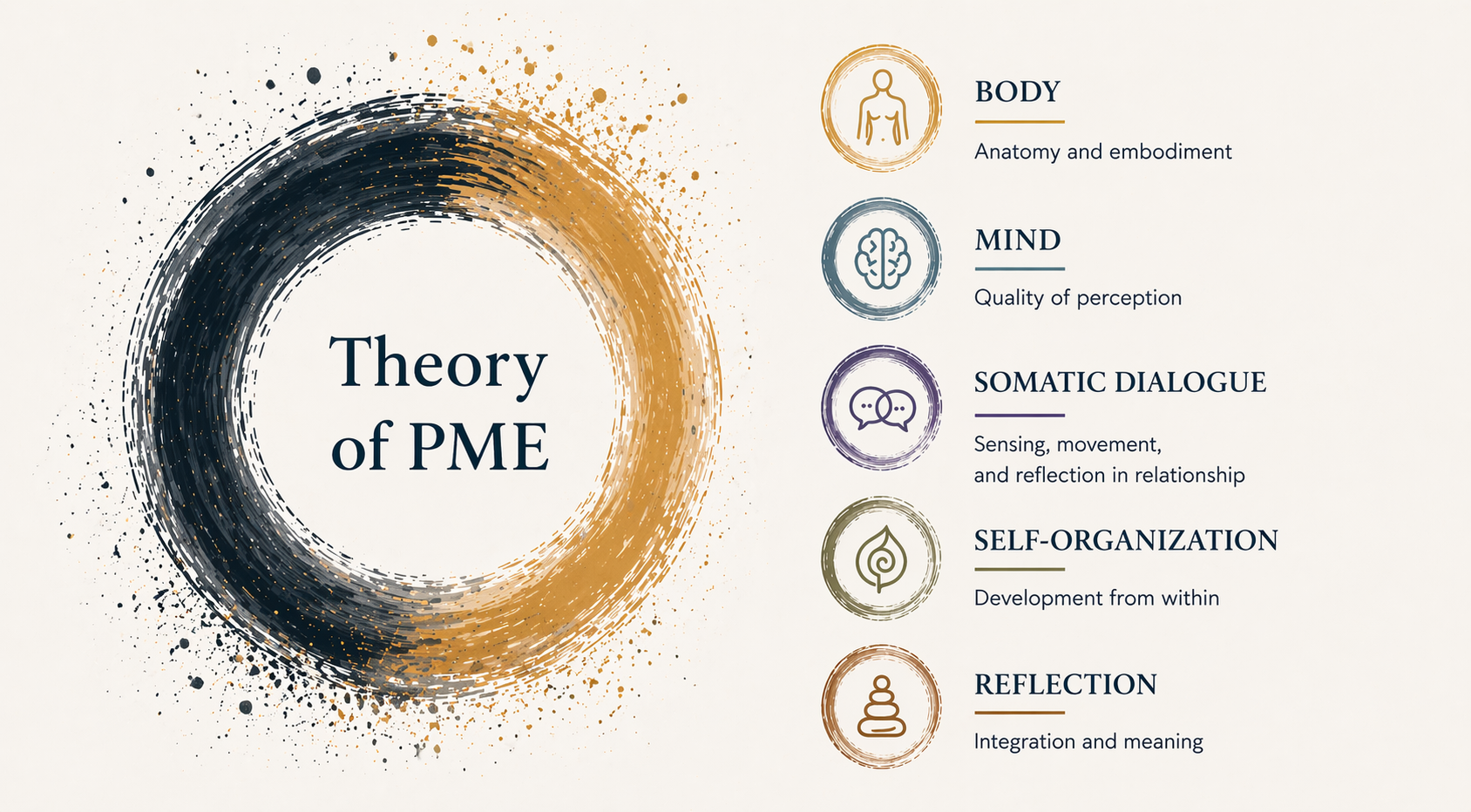
Theory of PME introduces the core conceptual and experiential foundations of our approach. You will explore the mind, perception, self-organization, and the Somatic Dialogue as a living process of sensing, movement, and reflection.
By understanding these principles in depth, you will be able to apply them more clearly, confidently, and efficiently in all further teachings and branches of PME.
completely online
12 hours over one weekend
Sat 03.04.2027 & Sun 04.04.2027
2pm – 8pm (Vienna time)
The theory of PME is applied throughout all modules and across all branches of the training. Exploring it in a focused and explicit way creates a clear orientation, allowing participants to recognize and integrate these principles more easily and efficiently in all further teachings and practical applications.
This module introduces the theoretical foundations of PME through direct experiential orientation. Theory is approached not as abstraction, but as something that can be perceived, differentiated, and reflected in lived experience.
Somatics is understood as first-person inquiry into embodied experience. It enables the differentiation and reorganisation of experience from within.
PME integrates somatic, dance, philosohical, psychotherapeutic, contemplative, massage, and systems-theoretical traditions into a coherent, process-oriented framework.
The mind is understood as a continuous process of perception—defined as that which knows its object. Both the content and the quality of perception shape action and development.
Human functioning is organised through the interaction of an experiential (embodied, fast) and a rational (reflective, conceptual) system.
PME engages and integrates both.
The core process of PME: a cyclic interaction of sensing, movement, and reflection.
This recursive process enables differentiation, integration, and transformation through self-organisation.
PME understands development as an emergent process of self-organisation. Transformation is not imposed externally but unfolds from within the organism through structured engagement with embodied experience.
The Somatic Dialogue creates the conditions under which the system reorganizes itself toward more coherent, adaptive, and viable patterns.
Movement is not only expression but the central medium of transformation.
It reveals existing organisation, refines perception, generates variation and fluctuation, and enables the emergence of new patterns of coordination, affect, and behaviour. Through movement, the system actively reorganizes itself.
Experience unfolds within a multi-dimensional and polyphonic field in which sensation, emotion, cognition, and movement interact simultaneously.
This field includes temporal dimensions (past, present, future) and spatial dimensions (internal/external, proximal/distal, body orientations).
The “grid of attention” refers to the capacity to differentiate and navigate this complex, co-present field, allowing processes to be perceived, related, and reorganized.
Perception is an active and qualitative process. The way experience is sensed—e.g. with mindfulness and compassion—functions as a regulatory parameter that shapes the emergence and direction of self-organisation and development.
PME works with the organism’s inherent capacities. The process supports autonomy, self-regulation, and resource activation rather than external control.
Experience is actively constructed through recursive feedback loops of sensing and action. Change occurs through ongoing reorganisation toward more viable forms of functioning.
Reflection integrates embodied processes into language and meaning. Idiolectic approaches support precise, experience-near articulation without imposing external interpretation.
PME is situated within broader traditions that emphasize awareness, self-regulation, and the unfolding of inherent capacities.
Subjective experience is approached as a systematic source of knowledge, accessible through structured sensing, movement, and reflection.
Participants learn how theoretical principles directly shape perception, interaction, and regulation. This creates a precise bridge between conceptual understanding and practical application within PME.

If you did choose the payment option >pay per module< please book this workshop here
To participate in this module, you need to be enrolled in the Basic Somatic Training.